
'Interim Budget has ignited the entrepreneurial spirit.'

Railways, rural infrastructure, urban rejuvenation, solar and transmission and distribution of electricity are the new priorities, says Vinayak Chatterjee.

Tata Electronics on Saturday began the construction of its Rs 27,000-crore chip assembly plant in Assam, which is expected to become operational next year and create 27,000 jobs initially. The plant will produce 4.83 crore chips per day using indigenously-developed technologies. The plant's Bhumi Pujan (foundation stone laying) ceremony was held at the project site at Jagiroad in Morigaon district in the presence of Assam Chief Minister Himanta Biswa Sarma and Tata Sons Chairman N Chandrasekaran.
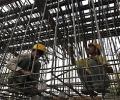
The economic slowdown has made it difficult for companies to record financial closure of a few awarded projects.

Relying on the private sector to undertake infrastructure investment may not be a realistic proposition.

According to an Andhra government statement, Naidu 'reposed confidence' in the PM's leadership.
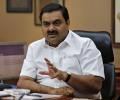
The Adani group is in advanced talks with top sovereign funds based in West Asia to raise up to $2.6 billion for its airport expansion and green hydrogen projects. The group, which expects to close the ongoing financial year ending March with Rs 80,000 crore of Ebitda (earnings before interest, tax, depreciation, and amortisation), has held a series of road shows in London, Dubai, and Singapore with potential investors, briefing them about their future growth plans. The group's flagship, Adani Enterprises, may dilute part of its stake in the airport-holding firm and/or the green hydrogen business to these funds, which are keen to invest in the Indian infrastructure sector, said a source close to the development.

The National Informatics Centre uses AI to automate document analysis and detect fraud in government departments.

The World Bank must become Archimedes's lever to help change the world into a more prosperous, inclusive, and sustainable planet in the 21st century. The change in leadership now provides that opportunity, observes Ajay Chhibber.

Combined debt-equity ratio of top companies declines but interest expenses outgrow profits.

Debt-saddled telecom operator Vodafone Idea Ltd's Rs 18,000 crore follow-on offering (FPO) opened to a modest response on Thursday with just 26 per cent of shares on offer being sought by investors. Of the 1,260 crore shares on offer, 331.24 crore was subscribed on Thursday, according to information on the BSE. Qualified institutional buyers picked up 61 per cent of their 360 crore shares reserved for them while non-institutional investors sought 28 per cent out of 270 crore shares earmarked for them.

'There will be 200 ITIs developed as hubs, while 800 will be developed as spoke, connected with five National Skill Training Institutes.'

'The stabilisation of interest rates followed by reduction is going to happen over the next year.'

'Like every Budget, this time, too, there is chatter around tinkering with the long-term capital gains tax.' 'Investors may not want to jump into the markets until there is clarity on this front.'

Tata Group remained India's largest business conglomerate in market capitalisation in calendar year 2023 while the Mukesh Ambani camp raced ahead of the Adani businesses to become the second-largest. The Tata companies ended 2023 with a combined group market capitalisation of Rs 28.68 trillion, up 35 per cent from the Rs 21.2 trillion at the end of December 2022. Ambani's group mcap is Rs 19.42 trillion at the end of CY23, up 10.7 per cent from the Rs 17.6 trillion a year ago.

While the corporate sector has benefited from massive capital expenditure, leading to sky-rocketing stock prices, investors would do well to keep an eye on the macroeconomic picture and government finances, not just corporate profits, for signs of trouble, alerts Debashis Basu.

The fourth finance ministerial meeting, to be held in New Delhi, will have Finance Minister P Chidambaram from the Indian side and Hyun Oh-seok, Deputy Prime Minister and minister of strategy and finance, from South Korea.


'They think quick fixes like internship in the private sector will help. 'In fact, internships have been going on for the last one decade.' 'In 2014-2015 itself, we had a ministry of skill development. None of the programmes have yielded results, still they are continuing with such schemes under some other name.' 'We don't see any seriousness on the part of the government to attack the problem of unemployment.'

There was no smooth surge in middle class prosperity for foreign businesses to tap into because of the Indian economy was mismanaged, argues Debashis Basu.


The two-wheeler segment has shown signs of recovery in the first half (H1) of calendar year (CY) 2024, largely driven by improving performance in rural areas. According to the Federation of Automobile Dealers Associations, rural contribution to two-wheeler sales surged by 57-60 per cent in the April-June quarter of 2024-25, indicating a rising demand in these regions. Experts believe that this trend will continue, supported by a favourable monsoon season and government initiatives aimed at rural development.

'The market has picked up for commercial vehicles. We are very close to pre-pandemic levels.'

Govt to chalk out entry of sovereign funds from Abu Dhabi, Qatar into such projects.

These firms owe Rs 13 trillion to lenders and account for 55% of all non-financial corporate debt.

The minister tells Subhomoy Bhattacharjee that he wants to set up a financing corporation for the road and shipping sectors, which will throw up a business opportunity of Rs 25 lakh crore!
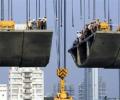
Banks have played a critical role in infrastructure financing.

'With NPA under control, we should be able to post better profits.'

Officials asked what the point was in going through banks when the government has to give guarantees.
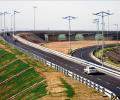
The markets regulator made it easier for banks to acquire control in listed companies.

Discussion paper fixes Rs 1,000 cr as minimum capital for these specialised banks

Adani Group on Wednesday said it will invest over Rs 12,400 crore in an array of projects including a data centre, clean energy project, and a cement plant in Telangana. The group signed four memorandums of understanding (MoUs) for the investments at the World Economic Forum in Davos in presence of Telangana Chief Minister Revanth Reddy and Adani Group chairman Gautam Adani. The conglomerate's flagship firm Adani Enterprises will invest Rs 5,000 crore in setting up a 100 MW data centre that will use green energy while its renewable energy unit Adani Green Energy Ltd will spend an equivalent amount in setting up two pump storage projects.

Kolkata tops the list with 617 cancellations, New Delhi stands second with 203, followed by Mumbai at 190.

Once declared a dud stock, Suzlon has generated stellar returns for investors thus far this calendar year. On a year-to-date (YTD) basis, Suzlon's share price has doubled investor wealth by soaring 109.35 per cent on the bourses. By comparison, the benchmark BSE Sensex has gained just 11.2 per cent.

The Cabinet has cleared a Bill to set up a government-owned development finance institution (DFI) with initial paid-up capital of Rs 20,000 crore so that it can leverage around Rs 3 trillion from the markets in a few years to provide long-term funds to infrastructure projects as well as for development needs of the country. To put it in perspective, Rs 3 trillion constitutes slightly less than 3 per cent of the Rs 111 trillion to be spent on over 7,000 projects in the National Infrastructure Pipeline from 2019-20 to 2024-25. Besides, the government will give Rs 5,000 crore as grant to the institution, Finance Minister Nirmala Sitharaman on Tuesday told the media after the Cabinet meeting.
'There have been many cases where clients have indicated that they feel suicidal as they feel they have no other options to deal with their financial hardship.'

With an existing consumer base of 400 million across airports, electricity and gas distribution businesses, the Adani group is revving up its retail play. It is planning to use the 2.4 billion consumer interactions a year with group companies to push various products and services. The group has already launched the 'Adani One' super app that will eventually sell products across the spectrum, top executives said.

Infrastructure Development Finance Company Ltd managing director and chief executive officer Rajiv B Lall has sold 4.50 lakh (450,000) shares of the company for over Rs 6.3 crore (Rs 63 million) in an open market transaction.

'Expectations are high regarding the change in LTCG with respect to equity investments.'

A lot depends upon the crucial decision-making skills of the management. If you have any doubts about the management then you always have the choice of selling your shares or not buying stocks of those companies at all.
